

Haitian Black Castor Oil Benefits for Face: 2026 Guide
Table of Contents
- What Makes Haitian Black Castor Oil Different for Your Face?
- Top 5 Haitian Black Castor Oil Benefits for Face Skin
- Does Black Castor Oil Clog Pores? A Comedogenic Analysis
- How to Apply Castor Oil to Face: A Step-by-Step Routine
- Haitian vs Jamaican Black Castor Oil: Which Is Better for Skin?
- Common Mistakes and What to Ignore
- Conclusion: Is Haitian Black Castor Oil Right for Your Routine?
- Frequently Asked Questions
Last Updated: September 8, 2026
What Makes Haitian Black Castor Oil Different for Your Face?
Most facial oils focus on hydration alone, but Haitian black castor oil benefits for face care go much deeper. Produced by roasting castor beans before pressing, it creates a darker, ash-rich oil with a thicker consistency than standard castor oil. The roasting process concentrates ricinoleic acid, a fatty acid known for its anti-inflammatory properties.

At Doyley's Beauty Care, we source our oil from castor beans indigenous to Haiti, where the traditional preparation method has been refined over generations. The result is an unrefined, hexane-free oil that retains more of its natural nutrients, including antioxidants and fatty acids that support the skin barrier.
This thick oil works differently than lighter carrier oils because its molecular structure penetrates deeply while creating a protective layer that reduces trans-epidermal water loss.
Top 5 Haitian Black Castor Oil Benefits for Face Skin
Ricinoleic acid makes up roughly 90 percent of castor oil's content. Here are the five benefits that matter most for facial skin.
Anti-Inflammatory Relief for Cystic Acne
Cystic acne forms deep beneath the skin's surface, where inflammation causes painful, swollen bumps. The ricinoleic acid in Haitian black castor oil has documented anti-inflammatory effects that soothe irritation and reduce visible redness associated with active cysts.

Ricinoleic acid acts on prostaglandin pathways, which is why the oil is often compared to non-steroidal anti-inflammatory agents. For cystic acne, it does not penetrate deep enough to resolve the root cause, but it reduces the surface-level inflammation that makes cysts painful.
Antimicrobial Action Against Breakouts
Beyond reducing inflammation, black castor oil benefits for face care include natural antimicrobial activity. Acne develops when pores become congested with sebum and bacteria, and the oil's antimicrobial properties address the bacterial component.
Medium-chain fatty acids like ricinoleic acid disrupt bacterial cell membranes, making it harder for Cutibacterium acnes, the primary bacteria involved in acne, to thrive.
Deep Moisture for Dry, Itchy Patches
Dry, flaky patches often signal a compromised skin barrier. Haitian black castor oil acts as both an occlusive and a humectant, drawing moisture into the skin while sealing it there.
As a humectant, it pulls water into the stratum corneum; as an occlusive, it forms a lipid film that helps reduce transepidermal water loss.
Collagen Support Through Fatty Acid Nourishment
While no topical oil can directly stimulate collagen production the way retinoids do, the fatty acids in Haitian black castor oil provide building blocks that support the skin's natural repair processes.
This benefit is cumulative. Consistent use can lead to better-hydrated skin, which reflects light more evenly.
Soothing Relief for Irritated, Sensitive Skin
Conditions like eczema, rosacea, and contact dermatitis involve an overactive inflammatory response. The gentle anti-inflammatory action of ricinoleic acid can help calm flare-ups.
Does Black Castor Oil Clog Pores? A Comedogenic Analysis
Castor oil has a comedogenic rating of 1 on a scale of 0 to 5, meaning a low likelihood of clogging pores. For comparison, coconut oil rates a 4, and many popular facial oils rate 3 or higher.
The low rating does not mean the oil works for everyone. People with oily or acne-prone skin may find the thick texture too heavy for daily use, but for dry, combination, or normal skin types, the risk of pore congestion is minimal.
A common mistake is using too much oil. Black castor oil is highly concentrated, so a few drops are sufficient for the entire face. Overapplication can leave a residue that traps dead skin cells, which is what actually leads to clogged pores rather than the oil itself. American Academy of Dermatology guidance on comedogenic oils recommends patch testing any new oil before full facial application.
How to Apply Castor Oil to Face: A Step-by-Step Routine
Start with a clean, slightly damp face, since the oil spreads more easily and locks in hydration. Warm two to three drops between your fingertips before pressing the oil gently into your skin.
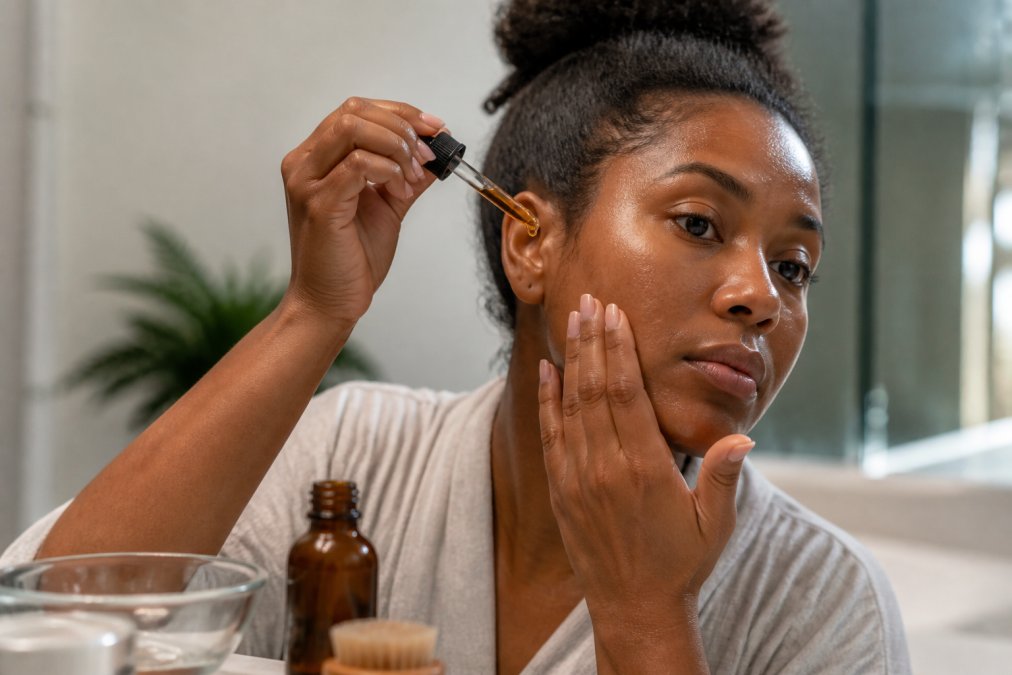
Use black castor oil as the final step in your evening routine, creating a protective barrier over lighter serums and moisturizers. In the morning, wash thoroughly to remove residual oil before applying sunscreen or makeup.
Skin Type Compatibility: Who Should Use This Oil and How Often
Haitian black castor oil is not one-size-fits-all. Its comedogenic rating of 1 means it is unlikely to clog pores for most people, but skin type determines how your face responds.
Dry and normal skin: This is the ideal candidate. Apply the oil every night as the final step. You can use up to four drops if your skin feels tight, but start with two and increase gradually.
Combination skin: Focus the oil on dry zones, typically the cheeks, jawline, and around the mouth, while using a lighter moisturizer on the T-zone. Apply the oil only at night and wash thoroughly in the morning. If you wake up with a greasy film, reduce to every other night or mix one drop with your night cream.
Oily and acne-prone skin: Proceed with caution. The oil's antimicrobial properties can help with breakouts, but the thick texture may feel heavy on already-oily skin. Start with one drop mixed into your moisturizer rather than applying it directly. Use it two to three nights per week, not daily. If you notice new blackheads or congestion, this oil may not be for your skin type.
Sensitive skin: The roasting process that creates Haitian black castor oil may introduce compounds that can irritate highly reactive skin. Always patch test first, and if you tolerate it, apply only to dry patches rather than the full face. Skip the oil entirely if you have active eczema flare-ups or broken skin.
Patch Testing Protocols: A Step-by-Step Safety Check
Before applying black castor oil to your entire face, test it on a small area behind your ear or along your jawline and wait 24 to 48 hours to check for irritation. Individual sensitivities vary, and the concentrated nature of Haitian black castor oil means even a small reaction can be uncomfortable.
For a more rigorous test, follow this protocol:
- Clean the test area with a gentle cleanser and pat dry.
- Apply a pea-sized amount of oil to a one-inch area behind your ear or on the inner forearm.
- Cover with a bandage and leave for 24 hours.
- Check for redness, itching, burning, or raised bumps. If any appear, wash the area immediately and do not use the oil on your face.
- If no reaction appears after 24 hours, apply the oil to a small patch on your jawline and leave it overnight.
- If you tolerate the overnight test, you can proceed with full facial application.
Layering With Other Skincare Actives: What Works and What Does Not
Black castor oil pairs well with hydrating ingredients like hyaluronic acid and glycerin, which draw water into the skin before the oil seals it in. Avoid layering it directly over strong actives such as retinoids or alpha hydroxy acids, as the oil may intensify their effects.
Here is a practical layering guide based on how different actives interact with a heavy occlusive oil:
Hyaluronic acid and glycerin: Apply these water-based serums first on damp skin, then seal with the oil. This is the safest and most effective pairing.
Niacinamide: This active works well under the oil. Apply niacinamide after cleansing, wait two to three minutes for it to absorb, then follow with the oil.
Vitamin C (L-ascorbic acid): Use vitamin C in the morning and the oil at night. Vitamin C is unstable and oxidizes quickly; layering a heavy oil over it can accelerate degradation. If you must use both at night, apply vitamin C first, wait 15 minutes, then the oil.
Retinol and prescription retinoids: Do not layer these directly with black castor oil. The oil may increase skin permeability, which could drive retinoids deeper than intended and cause irritation. Use retinoids on alternating nights, or apply the oil in the morning and the retinoid at night.
Alpha hydroxy acids (glycolic, lactic, mandelic): These exfoliants work by dissolving the bonds between dead skin cells. Applying a heavy oil immediately after may trap those loosened cells on the surface, potentially leading to congestion. Wait at least 30 minutes after applying an AHA before adding the oil.
Haitian vs Jamaican Black Castor Oil: Which Is Better for Skin?
Both oils come from the same plant, but their processing differs. Jamaican black castor oil is roasted longer and at higher temperatures, resulting in a thicker oil with higher ash content. Haitian black castor oil, also known as Lwil Maskriti, undergoes a gentler roasting process that yields a lighter texture while preserving more fatty acids.
For facial use, the lighter texture of Haitian black castor oil benefits for face routines because it absorbs more readily without leaving a heavy film. The higher ash content in Jamaican oil can be beneficial for scalp treatments but may feel too gritty or thick for delicate facial skin. National Institutes of Health research on castor oil fatty acid composition confirms that both oils retain ricinoleic acid, but the processing differences affect viscosity and feel.
| Oil Type | Texture | Ash Content | Best For |
|---|---|---|---|
| Haitian Black Castor Oil | Lighter, more absorbent | Lower | Facial skin, daily moisturizing |
| Jamaican Black Castor Oil | Thicker, heavier | Higher | Scalp treatments, hair growth |
| 1:1 Blend | Balanced | Moderate | Multi-purpose use |
If you want the benefits of both without choosing, Doyley's offers a premium Haitian and Jamaican blend that balances the lighter texture of Haitian oil with the potency of Jamaican processing.

Common Mistakes and What to Ignore
The biggest mistake is expecting overnight results. Natural oils work gradually, and consistent use for several weeks may be needed before noticing changes.
Another error is treating black castor oil like a spot treatment for active acne. It works best as a preventive and restorative treatment rather than a quick fix; applying it to broken skin may trap bacteria and worsen the situation.
Ignore the myth that all oils are the same. The comedogenic rating and fatty acid profile of castor oil make it fundamentally different from heavier oils like coconut or olive oil. Also disregard advice to dilute black castor oil heavily with water, since oil and water do not mix. If the oil feels too thick, blend it with a lighter carrier oil like jojoba or squalane instead. Cleveland Clinic overview of castor oil uses and safety provides additional guidance on safe topical application.
Conclusion: Is Haitian Black Castor Oil Right for Your Routine?
Haitian black castor oil is not a universal solution, but for many skin types it offers a rare combination of anti-inflammatory, antimicrobial, and deeply moisturizing benefits. Its low comedogenic rating makes it suitable for most people, provided you patch test first.
If you have dry, combination, or normal skin and struggle with inflammation, recurring breakouts, or tight, dehydrated patches, this oil deserves a place in your regimen. Those with very oily skin may prefer using it only on dry areas.
Doyley's Beauty Care offers authentic Haitian black castor oil in both 4oz and 8oz sizes, sourced from castor beans indigenous to Haiti and processed without hexane. For those who want the best of both traditions, our 1:1 Haitian and Jamaican blend delivers the absorbency of Haitian oil with the potency of Jamaican processing.
Frequently Asked Questions
What does putting black castor oil on your face do?
Putting Haitian black castor oil on your face delivers ricinoleic acid, a fatty acid with anti-inflammatory and antimicrobial properties. This combination helps calm cystic acne, reduce redness, and fight bacteria that cause breakouts. Its thick, humectant nature also seals in moisture, which supports the skin barrier and reduces trans-epidermal water loss. Over time, regular topical application can improve skin texture and soften the appearance of fine lines, making it a versatile addition to a nightly skincare routine.
Does black castor oil clog pores?
Black castor oil has a comedogenic rating of 1, meaning it has a very low likelihood of clogging pores. This makes it a safe option for most skin types, including those prone to acne. However, because the oil is thick and heavy, applying too much can trap dead skin cells and sebum on the surface, which may lead to congestion. Start with a single drop, warm it between your fingers, and press it into the skin rather than rubbing it on to minimize any risk of pore blockage.
Which is better, Haitian or Jamaican castor oil?
Neither oil is inherently better; they simply suit different needs. Haitian black castor oil is traditionally lighter in color and texture, which makes it easier to spread and quicker to absorb. This quality is ideal for facial use, especially if you are layering it under a moisturizer. Jamaican black castor oil is thicker with a higher ash content from its roasting process. That density is popular for hair, but it can feel too heavy on facial skin. For facial benefits, Haitian oil is usually the more practical choice.
Can you leave Haitian black castor oil on your face overnight?
Yes, you can leave a small amount of Haitian black castor oil on your face overnight. Its fatty acids work to support the skin barrier and lock in moisture while you sleep. The key is moderation: use no more than one or two drops for your entire face. Applying a thick layer can feel sticky and may transfer to your pillowcase. If you have very oily or acne-prone skin, start by leaving it on for 30 minutes to an hour to see how your skin reacts before committing to an overnight routine.
Finding the right facial oil takes experimentation, but black castor oil's unique fatty acid profile makes it worth trying for anyone seeking natural solutions to inflammation, dryness, and breakouts. Start with a patch test, apply sparingly, and give your skin time to respond. Get started with Doyley's Beauty Care and discover how authentic Haitian black castor oil can transform your skincare routine.