

Natural Ways to Retain Length for Curly Hair
Table of Contents
- Why Curly Hair Breaks Before It Grows: The Length Retention Basics
- How to Detangle Curly Hair Without Breakage
- How to Moisturize Curly Hair So It Stays Hydrated All Week
- Protective Hairstyles for Length Retention (and How to Install Them Safely)
- How Often to Trim Curly Hair Without Losing Progress
- Nighttime Protection: Satin Scarves, Bonnets, and Ends Care
- Troubleshooting Breakage by Cause: A Simple Diagnostic Routine
- Conclusion: Building a Natural Length Retention Routine That Fits Your Life
- Frequently Asked Questions
Last Updated: October 13, 2026
Why Curly Hair Breaks Before It Grows: The Length Retention Basics
If your hair seems stuck at the same length, the problem is usually breakage, not growth. Natural ways to retain length for curly hair start with one shift: stop chasing growth and protect what you already grow, so your routine helps you retain length week after week.
Growth vs. Retention: Two Different Numbers
Growth happens at the scalp; retention happens at the ends, and only one is in your control.
- Growth is the length your follicles produce each month.
- Retention is how much of that length survives washing, styling, and sleeping.
You cannot speed up growth much, but you can protect retention every day.
How Shrinkage Hides Progress (and How to Measure Past It)
Shrinkage makes curly hair look shorter than it is. A coil can spring up to half its stretched length, so your hair may be growing while your mirror says otherwise.
To measure real progress, track stretched length instead:
- Pick a small section of hair.
- Gently pull it straight without tugging the root.
- Measure from scalp to end with a soft tape.
- Record the number and date.
- Repeat every 8 to 12 weeks on dry, product-free hair.
A length check done this way shows retention; a wash-day photo does not.
How to Detangle Curly Hair Without Breakage
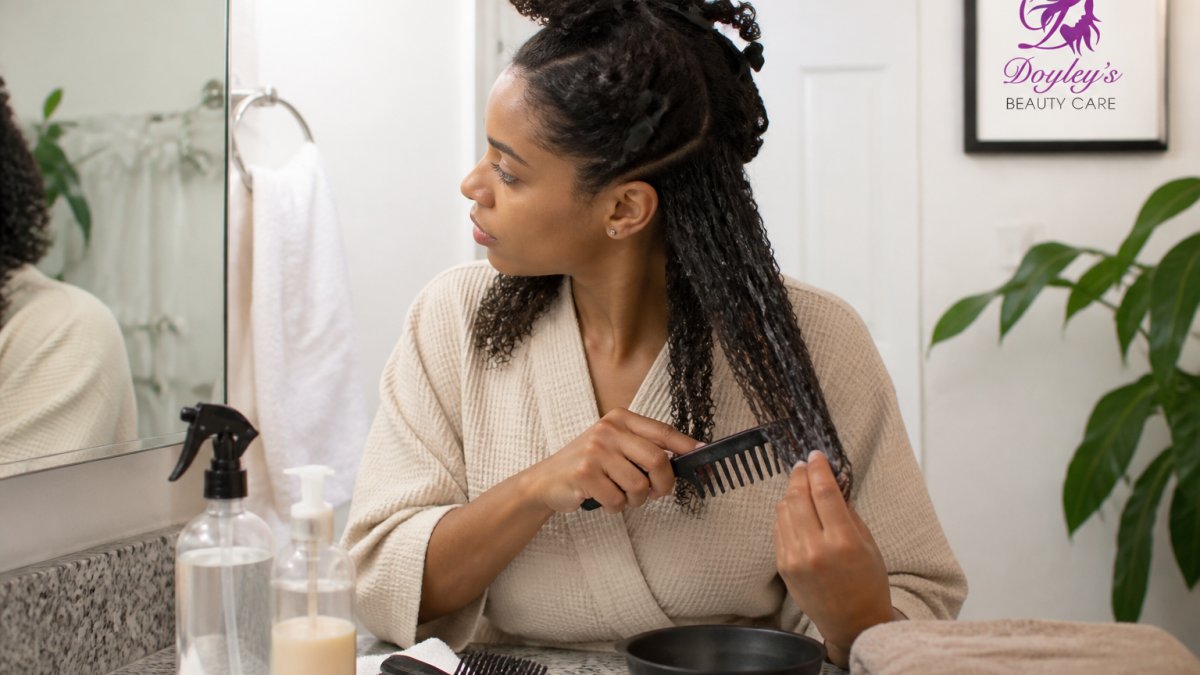
Detangling is where most length disappears. Curly hair tangles around itself, and dry detangling snaps strands at the weakest point. Add slip first, then work in small sections.
The Pre-Poo and Sectioning Method
A pre-poo is a treatment applied before shampoo to coat hair and reduce friction during washing, one of the most underused steps in curly hair care.
Here is how we would do it:
- Apply a rich oil or conditioner to dry hair, ends first
- Cover with a plastic cap for 20 to 30 minutes
- Divide hair into 4 to 6 clipped sections
Our Doyley's Haitian Black Castor Oil Mega Moisture Leave-In Conditioner Detangler is enriched with Chebe Powder, Rosemary, and Peppermint Oils to deeply hydrate, soften, and detangle your hair while promoting manageability.
How to Moisturize Curly Hair So It Stays Hydrated All Week
Dry hair breaks. Curly hair loses moisture faster because natural oils struggle to travel down a coiled strand, so mid-lengths and ends dry out first even when your scalp feels fine.
The answer is layering, not one heavy product, and layering only works when each layer does a different job.
Know Your Product Roles Before You Buy Anything
A simple routine has distinct jobs, each needing a different product:
- Cleanser, lifts buildup without stripping. Look for gentle surfactants, not clarifying formulas for every wash.
- Conditioner, smooths the cuticle and adds slip so strands can slide past each other instead of snapping.
- Leave-in, holds water against the strand after rinsing. This is the layer that keeps hair soft past day one.
Name each bottle's job and you can build a routine without guessing, and drop duplicates.
Match the Routine to Your Porosity, Not Just Your Curl Pattern
Curl pattern tells you the shape of your hair; porosity tells you how it behaves with water, and decides how often you moisturize.
- Low porosity, the cuticle lies flat and water beads up. Products sit on top instead of absorbing. Use lightweight leave-ins, apply on damp hair with warmth (a plastic cap or a warm towel helps), and avoid heavy butters that coat without penetrating.
- Medium porosity, the easiest to work with. Standard layering holds for several days, and a weekly deep condition is usually enough.
- High porosity, the cuticle is raised and water escapes fast. Hair drinks quickly and dries quickly. Reach for richer leave-ins, seal with an oil or pomade, and deep condition more often, sometimes weekly.
A common pattern: someone with high porosity buys a lightweight mist meant for low porosity hair, gets two good hours, and blames the product. The match was wrong, not the product.
The Order That Actually Holds Water In
- Water first. Always start on damp hair. Dry hair cannot be moisturized by oil alone.
- Then a leave-in. This holds the water in.
- Then an oil or pomade. This seals the surface.
Deep condition every 1 to 2 weeks. Our Doyley's Haitian Black Castor Oil Mega Moisture Deep Conditioner is expertly crafted with Haitian Black Castor Oil and Chebe Powder to deliver intense hydration, improve manageability and strengthen your hair.

For sealing, our Doyley's Haitian Black Castor Oil Hair Pomade coats the hair shaft to lock in moisture, hold hair in place, add shine and reduce frizz. For excellent hold with a non-greasy texture, use our Haitian castor oil pomade to maintain your locks, twists, waves, slick-back and other types of structured hairstyles.

Why Moisture Fails by Mid-Week (and How to Refresh Without Starting Over)
If hair feels dry on day three, the cause is usually one of four things:
- You sealed over dry hair. The oil locked in nothing. Re-wet the section with water and leave-in before sealing again.
- Your sealant is too heavy for your porosity. Switch to a lighter oil for low porosity, a richer one for high porosity.
- You slept on cotton. The pillowcase pulled the moisture out overnight. A satin scarf or bonnet fixes this faster than any product.
A refresh does not mean re-washing. Spritz one section at a time with water, smooth in a little leave-in, seal the ends, and leave it alone, working in sections prevents re-tangling.
Protective Hairstyles for Length Retention (and How to Install Them Safely)
Protective hairstyles for length retention work by tucking the ends away from friction. The ends are the oldest and weakest part of your hair, so they break first, cover them and you keep more length. But a protective style can cause damage if installed too tightly, and traction at the hairline shows up as thinning edges that take a long time to recover.
What "Too Tight" Actually Feels Like
Tightness is a signal, not a feeling to push through. Check these before you leave the chair or finish the last twist:
- The raise test. Lift your eyebrows. If your scalp pulls or stings, the style is too tight at the hairline.
- The two-finger test. You should be able to slide two fingers under the base of each braid or twist near your edges. If you cannot, it is pulling.
- The pain test. Any sharp pain, throbbing, or headache within the first hour means take it down. Discomfort that fades in a day is different from pain that does not.
If a stylist says tight is normal, speak up or find someone else.
Safe Installation Rules
- Skip styles that pull at your temples and nape
- Avoid heavy braids or twists on fragile edges
- Keep the style in for a few weeks, not a few months
How Long Is Too Long
A protective style is not set-and-forget. The longer it stays in, the more shed hair accumulates at the root and the more likely the take-down becomes a breaking event.
A practical range most people can tolerate:
- Two to four weeks for braids, twists, and cornrows on fine or fragile hair
- Four to six weeks for thicker, stronger hair with a healthy scalp
- Longer than six weeks raises the risk of matting, buildup, and difficult take-down, even on strong hair
The take-down matters as much as the install. Work with oil on your fingers, undo one section at a time, and detangle before moving on, rushing it is where a lot of length quietly disappears.
Keep the Scalp Clean and Reachable
A style that seals your scalp off from cleansing will itch, flake, and make you scratch, its own form of damage.
- Use a nozzle-tip bottle to apply diluted shampoo or a scalp rinse between the parts.
- Pat, do not scratch, if your scalp itches.
- Keep the scalp dry between washes so moisture does not sit at the roots.
Our Doyley's Haitian Black Castor Oil is a simple option for massaging the scalp and sealing the ends during the weeks a style is in. Rich in ricinoleic acid and omega-6 fatty acids, this castor oil has great moisturizing properties that help combat dry, flaky, itchy scalps.
Low-Manipulation and Heat-Free Styling Options
Low-manipulation styling means touching your hair less often during the week.
Heat-free options that protect your ends:
- Two-strand twists
- Flat twists under a scarf
- Bantu knots
Heat damage is permanent, once a curl pattern loosens from direct heat, it does not spring back. If you use heat, keep it rare and always use a protectant.
Signs a Style Is Causing Damage (Take It Down Now)
Do not wait for the scheduled take-down if you notice any of these:
- Thinning or a widening part along the hairline
- Bumps, scabs, or crusting at the edges
- Persistent itching or tenderness that does not settle
Edges that thin from traction can take months to look fuller again. If you see patches of hair loss, scalp pain, or sudden shedding, see a dermatologist, some causes of hair loss are medical and need a professional, not a product.
How Often to Trim Curly Hair Without Losing Progress
Trim every 8 to 12 weeks if your ends are splitting, and less often if they are healthy. Trimming does not make hair grow faster, but it stops split ends from traveling up the strand and stealing length you already have.
Check your ends every few weeks:
- Do they feel rough or dry compared to the mid-shaft?
- Do single strands split into two or three?
- Do knots form at the very tips?
If yes to any of these, a trim is due. If your ends feel smooth and strong, you can wait.
Nighttime Protection: Satin Scarves, Bonnets, and Ends Care
Cotton pillowcases pull moisture out of your hair and create friction while you sleep. Satin does not.
Your nighttime routine:
- Moisturize and seal your ends before bed
- Loose-pineapple your hair on top of your head
- Cover with a satin scarf or bonnet
Ends protection is not glamorous, just effective, the ends are the oldest hair on your head, so give them a break at night.
A small amount of Doyley's Haitian Black Castor Oil on your ends before bed is a simple way to seal in moisture.
Troubleshooting Breakage by Cause: A Simple Diagnostic Routine
Breakage has a cause, and the fix depends on which one you have.
| What You See | Likely Cause | What to Change |
|---|---|---|
| Short broken pieces on the sink | Dry detangling or rough combing | Pre-poo and section before combing |
| Split ends that travel upward | Missing trims and dry ends | Trim every 8-12 weeks, seal ends |
| Thinning along the hairline | Tight protective styles | Loosen installs, rest the edges |
| Crunchy, stiff strands | Too much protein, not enough moisture | Add water-based leave-in |
| Limp, mushy hair | Too much oil or product buildup | Clarify, then deep condition |
| Breakage in one spot only | Friction from a scarf, hat, or chair | Change the fabric or the habit |
Work through the list one cause at a time. Change one thing, wait two weeks, and check again. If breakage continues along with scalp pain, patches of hair loss, or sudden shedding, see a dermatologist. Some causes of hair loss are medical and need a professional, not a product.
Conclusion: Building a Natural Length Retention Routine That Fits Your Life
Retaining length is not about one miracle product. It is about handling, moisture, protection, and patience, repeated week after week. The routine that works is the one you can actually keep.
Doyley's Beauty Care makes authentic Haitian Black Castor Oil products designed to support moisture, conditioning, and reduced breakage.

Add to cart and start building a routine that helps your curls hold onto every inch.
Frequently Asked Questions
How can I retain length in my curly hair?
Focus on reducing breakage rather than speeding up growth. Detangle wet hair in small sections with a slippery leave-in, deep condition weekly, wear low-manipulation styles, protect your ends at night with a satin scarf or bonnet, and trim only when you see split or damaged ends. Our Haitian Black Castor Oil Mega Moisture Leave-In Conditioner Detangler helps soften curls so you can detangle with less friction, which supports length retention over time.
How often should I trim curly hair to retain length?
There is no single schedule that fits every head of curls. Check your ends monthly for splits, knots, and rough texture. If you find them, trim them rather than waiting, because split ends travel up the strand and cost you more length than the trim would. Many people with curly hair trim every 8 to 12 weeks, while those with frequent single-strand knots or heavy heat or color use may need to trim sooner.
Do protective styles help curly hair retain length?
Yes, when they are installed and removed gently. Braids, twists, and flat twists keep your ends tucked away from friction and daily manipulation. The risk is tension: styles that pull at the hairline, stay in too long, or are taken down dry can cause breakage and thinning edges. Keep sections comfortable, moisturize underneath, and never rush the takedown.
How can I keep curly hair moisturized without weighing it down?
Apply moisture to damp hair in layers: a water-based leave-in first, then a light oil or pomade to seal. Use small amounts and focus on your ends, which dry out first. Doyley's Haitian Black Castor Oil Hair Pomade coats the hair shaft to lock in moisture, hold hair in place, add shine and reduce frizz. For excellent hold with a non-greasy texture, use our Haitian castor oil pomade to maintain your locks, twists, waves, slick-back and other types of structured hairstyles. Fine hair should start with a pea-sized amount and build from there.