

Why Haitian Castor Oil Is Expensive: What You're Really Paying For
Table of Contents
- The Price Premium: Understanding Haitian Castor Oil Costs
- Haitian Black Castor Oil vs Regular Castor Oil: What's the Difference
- How Haitian Black Castor Oil Is Made: Traditional Production Methods
- Authentic Haitian Black Castor Oil: How to Verify Quality and Purity
- Supply Chain Economics: Why Production Costs Matter
- How to Use Black Castor Oil for Hair: Maximizing Your Investment
- Is the Premium Price Worth It? What Results You Can Expect
- Frequently Asked Questions
Last Updated: October 9, 2026
The Price Premium: Understanding Haitian Castor Oil Costs
Haitian castor oil expensive compared to regular castor oil or oil from other origins, and understanding why matters. The difference reflects genuine distinctions in how the oil is produced, where it comes from, and what sets it apart. Understanding why Haitian castor oil is expensive means looking beyond the bottle to production economics, oil chemistry, and the labor-intensive methods behind authentic products.
At Doyley's Beauty Care, we source our Haitian Black Castor Oil from the finest castor beans indigenous to Haiti, and we've seen firsthand why this origin commands premium pricing. The supply chain, traditional processing, and quality standards all contribute to what you pay. Authentic Haitian castor oil is a specific product made a specific way in a specific place, not a generic commodity.

The economics matter because they affect what ends up in your bottle. Small-batch production, hand-roasting, and traditional pressing cost more than industrial processing. Smaller yields, stricter quality control, and the realities of sourcing from Haiti all factor into the final price. These aren't marketing justifications, they're structural realities.
Haitian Black Castor Oil vs Regular Castor Oil: What's the Difference
Regular castor oil and Haitian black castor oil are not the same product, despite both coming from castor beans. The differences begin with processing and extend to composition, color, scent, and performance.

Regular castor oil is typically pale yellow or clear, produced through cold-pressing or solvent extraction at scale to maximize yield and minimize cost. The beans aren't roasted before pressing, which changes the final chemistry and sensory properties. It's lighter in texture with a mild or neutral scent.
Haitian black castor oil starts with roasted castor beans. Roasting is traditional and intentional: it darkens the oil, concentrates certain compounds, and creates the strong, distinctive scent that defines authentic black castor oil. The darker color comes partly from roasting and partly from higher ash content in traditionally processed oils. That's not a flaw; it's a signature of the method.
The composition differs measurably. Both oils contain ricinoleic acid and omega-6 fatty acids, but roasting concentrates these compounds differently.
Texture also differs. Regular castor oil flows more freely, while Haitian black castor oil is thicker and heavier. That thickness results from traditional processing and higher ash content. For some hair types it's an advantage; for others, it requires dilution or careful application.
How Haitian Black Castor Oil Is Made: Traditional Production Methods
Authentic Haitian castor oil is labor-intensive and relies on methods passed down through generations. How it's made explains both the quality and the cost.
Roasting and Pressing: The Traditional Process
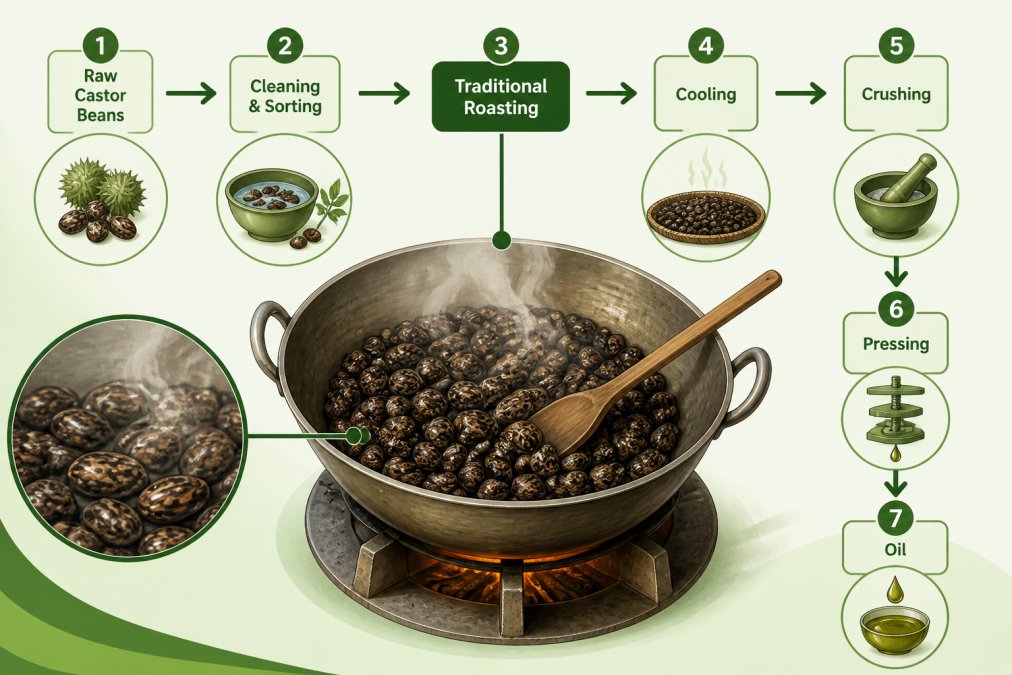
The defining step is roasting the castor beans before pressing. Producers heat whole beans in large metal pans or drums, stirring continuously for even roasting at moderate temperatures, hot enough to darken the beans and activate compounds without degrading the oil.
Roasting serves multiple purposes: it deepens the oil's color from pale yellow to dark brown or black, concentrates the earthy aroma characteristic of authentic Haitian black castor oil, and breaks down the bean structure so pressing is more efficient. It's time-consuming and requires skill, since bean size, moisture, and ambient temperature vary by batch.

After roasting, the beans are pressed using mechanical presses, often hand-operated or powered by small engines. Small-batch producers might process 50 to 200 pounds of beans per batch, yielding relatively small quantities of oil. Industrial operations process thousands of pounds daily, but that's not how authentic Haitian castor oil is made.
The pressed oil is then filtered through cloth or fine mesh, allowing sediment to settle out. It's slower than industrial filtration but preserves more of the oil's natural compounds.
Small-Batch Production and Quality Control
Haitian black castor oil is produced in small batches, typically by individual farmers or small cooperatives. A single batch might yield 10 to 50 liters, radically different from industrial cosmetic production, where one run produces thousands of liters.
Small-batch production means higher per-unit costs: labor is spread across fewer units, equipment sits idle between batches, and there's no economy of scale. But it also enables quality control industrial production can't match. Each batch can be monitored individually and discarded if it doesn't meet standards.
Authenticity is easier to verify in small-batch systems. Producers know their supply chains directly, often growing the beans themselves or sourcing from neighboring farmers. Traceability is built in, not bolted on.
The time investment is significant. From roasting to filtering to bottling, a small batch takes days, while industrial pale castor oil can be produced in hours. That time differential translates directly to cost.
Authentic Haitian Black Castor Oil: How to Verify Quality and Purity
The premium price of Haitian castor oil makes it a target for adulteration. Verifying authenticity matters before buying.
Authentic Haitian black castor oil should be dark brown to black. Pale or golden oil is either regular castor oil or a blend. The darkness comes from roasting and ash content.
The scent is distinctive and strong: a pronounced, earthy aroma some describe as nutty or smoky, coming from the roasting process. If an oil labeled Haitian black castor oil has no scent or a faint one, question its authenticity.
Texture should be noticeably thick and heavy. Authentic Haitian black castor oil moves slowly and clings to the bottle; thin, watery oil is likely diluted or mislabeled.
Reputable producers are transparent about sourcing and processing, explaining where the beans come from and how they're processed. At Doyley's Beauty Care, we source from the finest castor beans indigenous to Haiti and maintain clear documentation of our supply chain.
Hexane-free status matters. Some commercial production uses hexane as a solvent to extract more oil. Hexane-free oils are extracted mechanically or by other methods.
Price consistency is a signal. If Haitian black castor oil is priced significantly lower than other authentic sources, be skeptical.
Supply Chain Economics: Why Production Costs Matter
Haiti's geography and infrastructure shape the economics of castor oil production, explaining part of why Haitian castor oil is expensive.
Castor beans grow well in Haiti's climate, and the country has a long history of castor cultivation. However, its agricultural export infrastructure is limited.
Labor costs in Haiti are lower than in developed countries, but traditional processing is so labor-intensive that even lower wages add up per unit of oil. A small-batch producer roasting by hand and pressing mechanically employs more people per liter than an industrial facility.
Why haitian castor oil expensive partly comes down to supply chain fragmentation. Haitian castor oil doesn't move through consolidated, optimized supply chains like commodity oils. Small producers sell to local middlemen, who sell to regional distributors, then international importers, then retailers.
Political and economic instability in Haiti can disrupt production and raise costs. Producers face risks manufacturers in stable countries don't, and insurance, security, and contingency planning add to operational expenses. These costs are reflected in final prices.
Demand is smaller than for commodity oils. Haitian black castor oil serves a niche market, while pale castor oil has industrial uses beyond cosmetics. Smaller demand means smaller production runs and higher per-unit costs; commodity oils benefit from massive scale, Haitian castor oil does not.
How to Use Black Castor Oil for Hair: Maximizing Your Investment
If you're investing in authentic Haitian castor oil, using it effectively helps you get the most from it.
Haitian black castor oil works best applied directly to the scalp and hair roots. Because it's thick, it won't distribute evenly if poured onto dry hair.
For length and ends, dilute the oil with a lighter oil or apply sparingly. The thickness that works on the scalp can feel heavy on fine hair.
Leave the oil on your scalp for at least 30 minutes to several hours before shampooing; overnight application is common. The longer it sits, the more time it has to condition. There's no strict time limit, and leaving it on overnight won't damage your hair.
Frequency matters. Once or twice weekly is typical; more frequent use can lead to buildup, especially on fine or thin hair.
Our Doyley's Haitian Black Castor Oil comes in 4oz and 8oz sizes. The 4oz bottle suits weekly scalp treatments, while the 8oz size works well for more frequent use or longer hair.
Is the Premium Price Worth It? What Results You Can Expect
Whether Haitian castor oil's premium price is justified depends on what you're seeking.
Haitian black castor oil offers benefits for scalp care. Its ricinoleic acid and fatty acids provide deep moisturizing and conditioning. For many users, that alone justifies the investment.
For hair, the benefits center on strength, shine, and length retention. The oil conditions the hair shaft, helping to reduce breakage and split ends.
Because authentic Haitian castor oil is thick and potent, you use less per application than with lighter oils. A 4oz bottle can last two to three months with weekly scalp applications, which makes the premium price more manageable per use.
The sensory experience matters to some users. The distinctive scent is polarizing: some love it as a sign of authenticity and potency, while others find it overpowering.
The premium price also reflects the ethics and economics of sourcing from Haiti. Buying authentic Haitian castor oil supports small producers and communities there. If that alignment matters to you, the higher cost carries value beyond the product itself.
For fine or thin hair, results may be more subtle. The thickness can feel heavy if not diluted or applied carefully, and diluting reduces the concentration of active compounds. Fine-haired users may experience different results than those with thicker textures.
Haitian castor oil's premium price reflects genuine differences in production, sourcing, and quality. If you're seeking authentic Haitian black castor oil for scalp care, hair strength, and conditioning, start with our Doyley's Haitian Black Castor Oil in 4oz to experience the difference authentic sourcing and traditional production make in your routine.
Frequently Asked Questions
What makes Haitian black castor oil different from regular castor oil?
Haitian black castor oil is produced using traditional roasting and pressing methods, which give it a darker color, thicker consistency, and higher ricinoleic acid content compared to regular castor oil. The roasting process creates its distinctive scent and potency. Regular castor oil is typically extracted using commercial processing and may be lighter in color. Our Doyley's Haitian Black Castor Oil retains these traditional characteristics, making it richer and more concentrated for hair and scalp care.
How can I tell if Haitian black castor oil is authentic?
Authentic Haitian black castor oil should be dark in color (not pale yellow), have a thick consistency, and carry a distinctive earthy scent from the roasting process. Look for products that specify they're sourced from castor beans indigenous to Haiti. Check the label for transparency about production methods and origin. Our Doyley's Haitian Black Castor Oil is sourced from the finest castor beans in Haiti and produced using traditional methods, ensuring authenticity and potency.
How long does it take to see results from using Haitian black castor oil for hair?
Results vary by individual and depend on how consistently you use the oil and your specific hair goals. Some people notice improved scalp hydration and reduced dryness within weeks of regular use. Hair strength and appearance improvements typically develop over several months of consistent application. For hair growth goals, patience is important, healthy hair growth is a gradual process. Using Doyley's Haitian Black Castor Oil regularly as part of your routine supports moisturizing, conditioning, and reduced breakage, which helps maintain hair health over time.
Is Haitian black castor oil worth the higher price compared to other castor oils?
The premium price reflects the traditional production methods, small-batch processing, supply chain costs, and authenticity verification required for genuine Haitian black castor oil. The higher ricinoleic acid content and potency mean you may need less product per application. When compared by actual usage and results, the investment often delivers better value for hair and scalp care than cheaper alternatives. Our Doyley's Haitian Black Castor Oil offers authentic sourcing and quality that justifies the investment for those serious about supporting healthy hair and scalp.