

Best Essential Oils for Hair Growth: 2026 Guide
Table of Contents
- Best Essential Oils for Hair Growth: Quick Comparison
- How Essential Oils Support Hair Follicles and Scalp Health
- The Top Essential Oils for Hair Growth
- How to Dilute Essential Oils for Scalp Application
- Benefits of Black Castor Oil for Hair
- Scalp Massage Techniques for Hair Growth
- Safety, Side Effects, and Who Should Avoid Essential Oils
- Conclusion
- Frequently Asked Questions
Last Updated: September 22, 2026
Best Essential Oils for Hair Growth: Quick Comparison
The best essential oils for hair growth are rosemary, peppermint, and lavender, and each one earns its place for a different reason. Rosemary supports scalp stimulation and blood circulation, peppermint delivers a cooling tingle that wakes up a sluggish scalp, and lavender calms irritation while conditioning the hair shaft. At Doyley's Beauty Care, we built our entire line around one more workhorse: authentic Haitian Black Castor Oil, which pairs with any of these oils in a carrier blend.

Below, we break down what each oil actually does, how to dilute it safely, and how to massage it in so you see results instead of just smelling nice. A common mistake is skipping the carrier oil entirely, and that mistake is the fastest route to an irritated scalp.
How Essential Oils Support Hair Follicles and Scalp Health
Essential oils support hair follicles by improving blood circulation to the scalp, reducing inflammation around the follicle, and delivering antimicrobial protection against buildup that clogs the follicle opening. The dermal papilla, the tiny structure at the base of each follicle, depends on steady blood flow to move nutrients into the hair cycle. When circulation stalls, the anagen phase shortens and shedding increases.
Many practitioners find that consistent topical application matters more than which single oil you choose.
The Top Essential Oils for Hair Growth
Rosemary, peppermint, and lavender are the three most studied and most widely used options for hair thinning. Each works differently, so the right pick depends on your scalp type and your goal.
| Oil | Main Action | Best For | Dilution |
|---|---|---|---|
| Rosemary | Boosts blood circulation | General hair thinning | 2-3 drops per tbsp carrier |
| Peppermint | Cooling stimulation | Oily, congested scalp | 1-2 drops per tbsp carrier |
| Lavender | Soothes and conditions | Sensitive, itchy scalp | 3-4 drops per tbsp carrier |
Rosemary Oil
Rosemary oil is the closest thing to a clinical standard among natural remedies. It supports blood circulation to the scalp and is often compared to prescription treatments in how it encourages follicular activity, though the evidence base is smaller and results build slowly. Use it if you want one oil to start with and you do not have a sensitive scalp.
Peppermint Oil
Peppermint oil creates a cooling sensation that increases blood flow at the surface. It suits people with sebum-heavy scalps because the menthol cuts through that heavy feeling. Start with the lowest dilution in the table. Too much peppermint oil on a reactive scalp produces burning, not growth.
Lavender Oil
Lavender oil is the gentlest of the three and the best entry point for reactive skin. It has anti-inflammatory and antimicrobial properties, which helps with the itching and flaking that often accompany hair thinning. It also softens the hair shaft, so hair feels less brittle while you wait for density changes.
How to Dilute Essential Oils for Scalp Application
| Situation | Dilution | Drops per 1 oz carrier |
|---|---|---|
| Sensitive or reactive scalp | 1% | 6 drops |
| Standard adult scalp | 2% | 12 drops |
| Thinning scalp, tolerant skin | 3% | 18 drops |
| Peppermint or cinnamon-family oils | 1-2% | 6-12 drops |
| Children 6-12 (scalp, short-term) | 0.5-1% | 3-6 drops |
Follow these steps:
- Measure one ounce of carrier oil into a clean, dark glass bottle.
- Add 12-18 drops of your chosen essential oil (or fewer, per the table above).
- Cap and shake for 30 seconds to combine.
- Patch test on your inner forearm and wait 24 hours before scalp use.
- Apply to the scalp with fingertips or a dropper, section by section.
- Store the blend in a cool, dark place and use it within 3-6 months.
A common pattern is that people over-dilute at first out of fear and see nothing, then over-concentrate to compensate and irritate the scalp. Pick a ratio from the table, hold it steady for 8-12 weeks, and only then adjust.
Doyley's Haitian Black Castor Oil 4oz →
Benefits of Black Castor Oil for Hair
Black castor oil is the carrier oil most often paired with essential oils for hair growth, and for good reason. It is rich in ricinoleic acid and omega-6 fatty acids, which give it moisturizing properties that combat dry, flaky, itchy scalps while coating the hair shaft to reduce breakage. Regular use supports shine and luster and strengthens roots over time.
Scalp Massage Techniques for Hair Growth
Scalp massage technique matters as much as the oil you use. Massage increases blood circulation to the follicle, which is the mechanism behind most of the growth benefit you get from topical oils. Five minutes a day is enough. Ten is better.
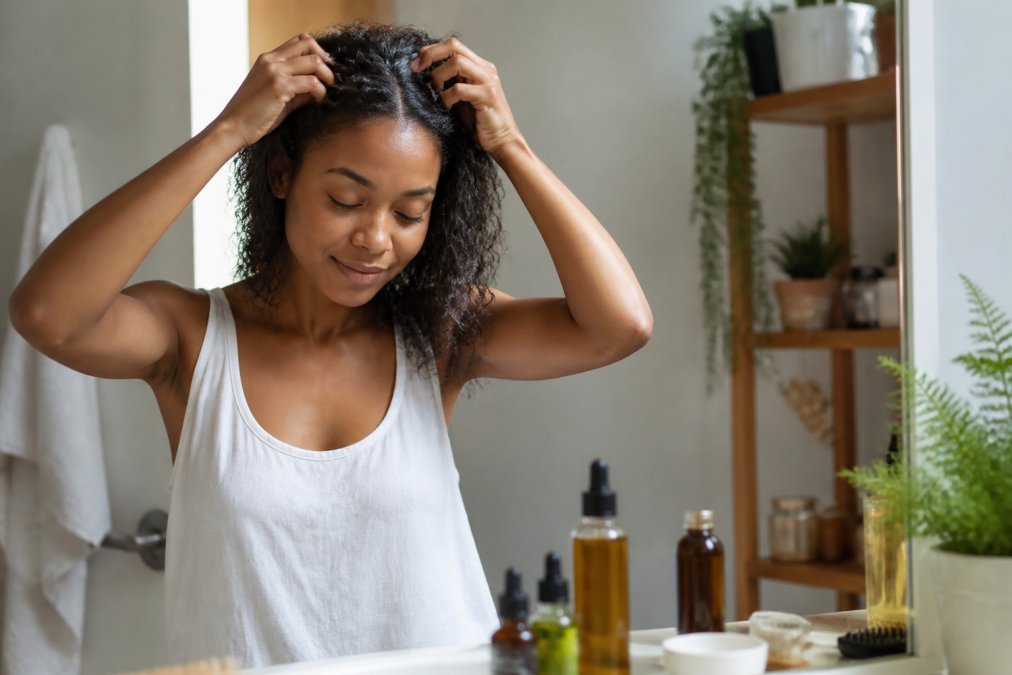
Try this routine:
- Place fingertips at the hairline and press gently.
- Move in small circles toward the crown, one inch at a time.
- Spend extra time at the temples and nape, where circulation is weakest.
- Use the pads of your fingers, never your nails.
- Finish with a two-minute press-and-hold at the crown.
Safety, Side Effects, and Who Should Avoid Essential Oils
Essential oils are not safe for everyone, and the risks are specific. This is the section most guides skip, so read it before you buy anything.
Who should avoid or get medical clearance first:
- Pregnancy and breastfeeding. Avoid rosemary, peppermint, clary sage, and sage. Some of these oils are traditionally used to influence uterine activity, and the topical data in pregnancy is thin. Ask your obstetric provider before using any essential oil on the scalp.
- Hormonal conditions. Lavender and tea tree oil have been reported in case literature to have estrogen-like activity with heavy, prolonged topical use. If you have a hormone-sensitive condition such as endometriosis, PCOS, or a history of hormone-receptor-positive breast cancer, talk to your doctor before regular scalp use.
- Epilepsy or seizure disorders. Avoid rosemary, eucalyptus, fennel, and hyssop. Several of these contain compounds (camphor, thujone) that are flagged as seizure-risk in aromatherapy safety literature.
- Blood-thinning medications. If you take warfarin, apixaban, rivaroxaban, or daily aspirin, be cautious with wintergreen, clove, and other salicylate-rich oils. They can add to bleeding risk.
- Eczema, psoriasis, or seborrheic dermatitis. Patch test every new oil, because fragrance compounds trigger flares. Start at 1% dilution, not 3%.
- Children under six. Do not use essential oils on the scalp at all. For ages 6-12, use 0.5-1% dilution and only short-term.
- Allergies to ragweed, daisies, or chrysanthemums. Avoid chamomile and other Asteraceae-family oils.
Conclusion
Natural hair care rewards patience and consistency more than it rewards a long shopping list. Pick one oil, dilute it properly, massage it in on a schedule, and give your scalp a few months to respond.
Frequently Asked Questions
Which essential oils are scientifically proven to support hair growth?
Rosemary oil has the strongest human trial evidence, with a 2015 study showing it matched 2% minoxidil for regrowth after six months. Peppermint oil showed faster regrowth than minoxidil in animal studies, and lavender oil improved follicle depth in mice. Most other oils rely on lab or animal data, not human trials. Treat the research as promising but limited, and use essential oils for hair growth as a support to your routine, not a replacement for proven treatments.
How do I safely dilute essential oils for scalp application?
Mix 3 to 5 drops of essential oil into 1 tablespoon (15 mL) of a carrier oil such as Haitian black castor oil, jojoba, or sweet almond oil. That gives a 1 to 2% dilution, which is safe for most adults. Always run a patch test on your inner arm 24 hours before full use. If your scalp is sensitive, start at 1 drop per tablespoon and increase slowly. Never apply undiluted essential oil directly to your scalp.
What are the benefits of black castor oil for hair?
Black castor oil is rich in ricinoleic acid and omega-6 fatty acids, which moisturize the scalp and help combat dryness, flaking, and itchiness. It coats the hair shaft to reduce breakage and split ends, and regular use can improve shine and softness. Many people use it as a carrier oil for essential oils for hair growth because its thick texture slows evaporation and keeps actives on the scalp longer.
How often should I apply essential oils to my scalp for best results?
Two to three times per week is enough for most people. More frequent use can irritate the scalp or cause buildup. Apply the diluted blend, massage for 5 to 10 minutes using scalp massage techniques for hair growth, and leave it on for at least 30 minutes or overnight before washing. Consistency over 8 to 12 weeks matters more than daily application. Stop and see a dermatologist if you notice redness, burning, or unusual shedding.
Can essential oils help with thinning hair or hair loss?
Essential oils may support mild thinning linked to poor scalp circulation or inflammation, but they cannot reverse pattern baldness, alopecia areata, or hair loss from medical conditions. If you take prescription hair loss treatments, check with your dermatologist before adding essential oils, since some can irritate skin already sensitized by those products. For diagnosed hair loss, essential oils work best as a complement to medical care, not a substitute.