

Does Black Castor Oil Clog Pores? Comedogenic Facts
Table of Contents
- What the Comedogenic Rating of Castor Oil Actually Means
- Does Black Castor Oil Clog Pores? The Short Answer
- Castor Oil Skin Purging vs Breakout: How to Tell the Difference
- How to Use Black Castor Oil for Acne Without Clogging Pores
- Cold-Pressed vs Refined: Extraction and What It Means for Your Skin Barrier
- Who Should Avoid Black Castor Oil on the Face
- Conclusion
- Frequently Asked Questions
Last Updated: September 14, 2026
What the Comedogenic Rating of Castor Oil Actually Means
The comedogenic rating of castor oil measures how likely an oil is to block pores, scored 0 to 5, where 0 means it will not clog pores and 5 means it is highly likely to. Castor oil sits at a 1, the low-risk category. That number is why so many people assume the answer to whether black castor oil clog pores is a simple no. It is not.

The scale itself is a rough guide, not a guarantee. It was developed from rabbit-ear testing decades ago, and the American Academy of Dermatology's guidance on acne and skin care notes that individual reactions vary widely based on skin type, concentration, and how a product is applied. An oil rated 1 can still cause problems for someone with very reactive, acne-prone skin, especially when it is layered thickly or left on overnight.
Customers read "comedogenic rating 1" and assume they can slather pure castor oil anywhere. The rating describes the oil in isolation, not the oil on your face under a heavy moisturizer.
Does Black Castor Oil Clog Pores? The Short Answer
Black castor oil does not clog pores for most people when used correctly, but it can contribute to pore blockage if applied undiluted, too often, or on already congested skin. The gap between "non-comedogenic" and "will not clog your pores" is where confusion starts.
Black castor oil is castor oil roasted and pressed, a traditional Haitian and Jamaican method that gives it a darker color and thicker texture. The comedogenic rating stays low because its dominant fatty acid, ricinoleic acid, is not particularly heavy on pores. What changes is viscosity: it is thicker than refined castor oil, and thick oils sit on the surface longer, which is where trouble begins.

Why Ricinoleic Acid and Fatty Acids Matter for Pore Blockage
Ricinoleic acid makes up the bulk of castor oil's fatty acid profile and is why it behaves differently from most plant oils. It is a monounsaturated fatty acid with a hydroxyl group, which gives castor oil its thickness and its ability to hold moisture against the skin.
That thickness is the catch. A thin oil like jojoba sinks in quickly; black castor oil lingers. On normal or dry skin, that means sustained hydration. On oily or acne-prone skin, a heavy occlusive layer can trap sebum and dead skin cells inside the follicle, exactly the environment comedones need.
The National Center for Biotechnology Information's overview of castor oil pharmacology describes ricinoleic acid as the compound responsible for both the oil's anti-inflammatory activity and its emollient, occlusive behavior. Both properties are real. Both matter. Neither one cancels out the other.
Castor Oil Skin Purging vs Breakout: How to Tell the Difference
Castor oil skin purging and a true breakout look similar for the first week, then diverge. Purging is a temporary acceleration of existing congestion: the oil speeds up cell turnover and everything already in your pores surfaces at once. A breakout is new inflammation from something your skin does not tolerate.
Here is how to separate them:
| Signal | Purging | Breakout |
|---|---|---|
| Timeline | Starts within days, clears in 2-4 weeks | Starts 1-2 weeks in, keeps worsening |
| Location | Where you already break out | New areas, often where you applied the oil |
| Type | Small whiteheads, blackheads, closed comedones | Red, inflamed, tender bumps or cysts |
| Trend | Improves steadily after week two | Gets worse with continued use |
Purging is not universal with castor oil; many people never experience it. If you see new inflamed bumps where you normally do not break out, that is not purging. Stop using the oil.
How to Use Black Castor Oil for Acne Without Clogging Pores
To use black castor oil on acne-prone skin without clogging pores, dilute it with a lighter carrier oil, apply a thin layer only where skin is dry, and keep it away from active breakouts. The goal is the oil's moisturizing and anti-inflammatory benefits without a heavy film across your face.
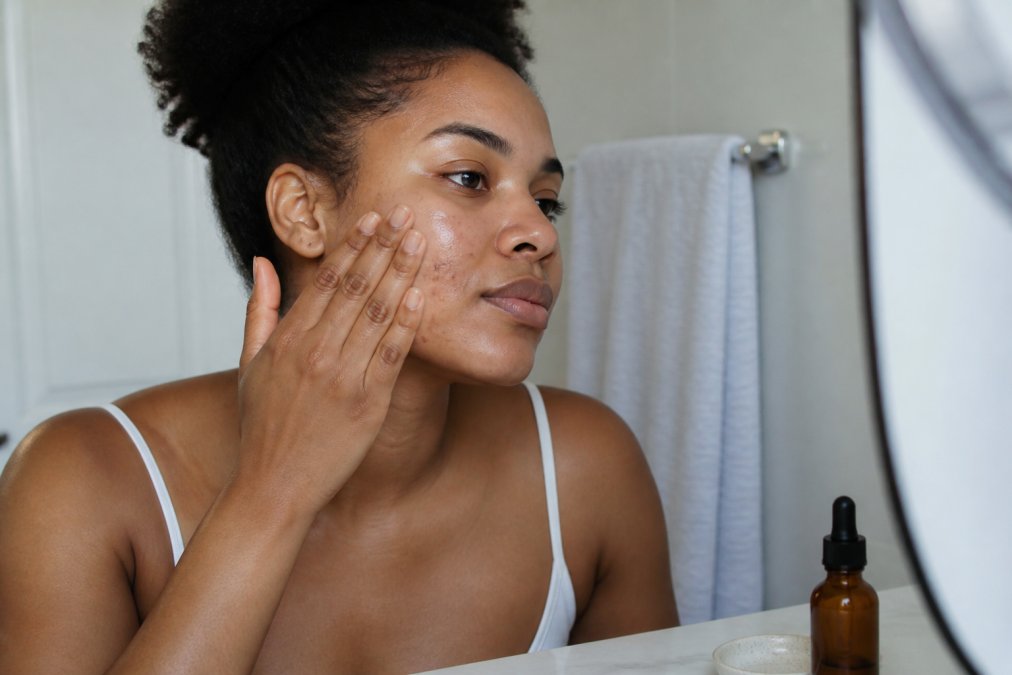
Start with a patch test on your jawline or behind your ear: apply a small amount, wait 24 hours, and check for redness, itching, or new bumps. It takes a day and saves weeks of guessing.
Once you know your skin tolerates it, follow this routine:
- Cleanse and pat dry. Oil goes on clean skin, never over makeup or sunscreen.
- Dilute. Mix one part black castor oil with two to three parts jojoba, grapeseed, or squalane.
- Warm two to three drops between your fingertips.
- Press, do not rub, into dry areas: cheeks, jaw, anywhere flaking.
- Skip active breakouts entirely. Oil on an inflamed pimple feeds the problem.
- Use at night, two to three times a week to start.
Dilution Ratios and Application Techniques by Skin Type
Different skin types need different ratios, and getting this wrong is the biggest reason people conclude that black castor oil clogs pores.
- Oily and acne-prone: 1 part black castor oil to 4 parts carrier oil, once or twice weekly, dry zones only.
- Combination: 1 part to 3 parts, two to three times weekly, avoiding the T-zone.
- Dry: 1 part to 2 parts, nightly if your skin tolerates it.
- Sensitive: 1 part to 4 parts, patch test first, start once weekly.
A common mistake is treating dilution as optional. Pure black castor oil is thick enough to feel like a mask, and that heaviness creates pore congestion for people prone to it.
If you want a formula that is already blended for easier spreading, Doyley's Premium Haitian and Jamaican Black Castor Oil 1:1 Blend 4oz combines a lighter Haitian oil with a thicker Jamaican oil.
Cold-Pressed vs Refined: Extraction and What It Means for Your Skin Barrier
Most articles answering whether black castor oil clogs pores never mention how the oil was made. That gap matters: extraction method changes the oil's texture, and texture feeds directly into pore congestion.
Cold-pressed castor oil is extracted by mechanically pressing the beans without applied heat, preserving more natural compounds including vitamin E and the fatty acid profile behind its emollient behavior. The trade-off: it is thicker, darker, and has a stronger scent. For dry skin and hair, that richness is the point.
Refined castor oil is filtered, often heated, and sometimes treated with activated carbon or clay to remove color and odor. The result is a lighter, clearer, nearly odorless oil that spreads easily and sits less heavily. For acne-prone skin, that lower viscosity is more forgiving, since a thinner oil is less likely to form the occlusive film that traps sebum and dead skin cells inside a follicle.
Black castor oil is its own category: castor oil roasted before pressing, a traditional Haitian and Jamaican method. Roasting darkens and thickens it further, which is why it feels more like a mask than refined castor oil and why dilution matters more.
Here is what the comedogenic rating does not capture: it is assigned to the oil in isolation, not as you apply it. A refined castor oil at a 1:3 dilution with grapeseed behaves very differently than pure roasted black castor oil straight from the bottle. Same fatty acid, different delivery. If you are prone to clogged pores, extraction method and dilution ratio do more work than the rating number.
This is where the skin barrier matters more than the comedogenic scale. A compromised barrier lets irritants in and loses water fast, showing up as flaking, stinging, and reactive breakouts. An emollient oil like castor oil can help rebuild it by slowing water loss, but an occlusive layer over a barrier already struggling with clogged follicles makes congestion worse. Your barrier decides which one it becomes.
The takeaway is not "avoid black castor oil" but "match the oil to the job." If your barrier is damaged and dry, a rich black castor oil helps. If your pores are congested and your barrier is intact, a lighter refined oil or diluted blend is better. When you shop, look for the extraction method on the label: "hexane-free" tells you what you are getting. A bottle listing none is likely refined, which is not a flaw, just a different product.
Who Should Avoid Black Castor Oil on the Face
Some people should skip black castor oil on the face entirely, at least until their skin settles. The oil is not inherently bad; certain conditions simply make a thick, occlusive, fatty-acid-rich oil do more harm than good.
- Active cystic acne. Cystic lesions are deep, inflamed blockages that have already ruptured below the surface. A heavy occlusive layer on top traps heat, sweat, and sebum against the skin and can increase pressure on an already inflamed follicle. Wait until deep breakouts are under control before introducing any rich oil, castor included.
- Seborrheic dermatitis or fungal acne (malassezia folliculitis). This is the most misunderstood contraindication. Malassezia is a yeast that feeds on certain fatty acids, and castor oil is roughly 85-90% ricinoleic acid by fatty acid profile (pubmed.ncbi.nlm.nih.gov). If your breakouts are itchy, uniform in size, and clustered on the forehead, hairline, or chest, they are more likely fungal than bacterial, and adding oil gives the yeast more fuel. The tell is the itch. Bacterial acne rarely itches the way fungal acne does.
- Known sensitivity to castor oil or its derivatives. Castor oil and its derivatives (including PEG-40 hydrogenated castor oil, a common emulsifier) appear in many cosmetics. If you have reacted to those, patch test carefully or skip it. A 24-hour patch test behind the ear or on the jawline will tell you what you need to know.
- Very oily skin with frequent clogged pores. You may get the same moisture benefit from a lighter, lower-viscosity oil with less congestion risk. Jojoba, squalane, and grapeseed all deliver emollience without the heavy film. There is no prize for using the thickest oil you can tolerate.
- Compromised or actively irritated skin barrier. If your skin is stinging, flushing, or peeling from over-exfoliation or a retinol adjustment, adding an occlusive oil can seal irritants against the skin and slow recovery. Repair the barrier first with ceramides and gentle hydration, then reintroduce oils.
A common pattern is blaming the oil for a breakout actually caused by layering it over an active or applying it to already congested skin. Before you write off black castor oil, check whether you used it on the right skin, at the right dilution, at the right time.
For everyone else, black castor oil remains a reasonable addition to a routine when it is diluted, applied sparingly, and given a few weeks to prove itself. If you want a single product that covers both skin and hair, Doyley's Haitian Black Castor Oil 4oz is the straightforward starting point, and the 8oz size makes more sense if you plan to use it on your scalp and body too.
Conclusion
Whether black castor oil clogs pores has a real answer, and it is more useful than a simple yes or no. At a comedogenic rating of 1, the oil itself is unlikely to block pores. What blocks pores is undiluted application, heavy layering, and using a rich oil on already congested skin. Dilute it, patch test it, keep it off active breakouts, and give it a few weeks.
Doyley's Beauty Care makes authentic Haitian Black Castor Oil sourced from castor beans indigenous to Haiti, formulated for all hair and skin types. Every bottle is hexane-free and made for people who want the real thing. Start with the 4oz bottle, patch test on your jawline, and build from there.
Frequently Asked Questions
Is it okay to put black castor oil on your face?
Yes, for most skin types, if you use it correctly. Black castor oil is an emollient and occlusive oil that can support skin hydration and barrier health. Apply a thin layer at night, two to three times a week, and always patch test first. If you have oily or acne-prone skin, dilute it with a lighter carrier oil such as jojoba or grapeseed to lower the risk of pore blockage and clogged follicles.
Can castor oil pull out blackheads?
No. Castor oil cannot extract blackheads or comedones from pores. Massage may loosen surface debris, but the oil itself does not pull out blackheads. Its role is to moisturize and support the skin barrier. For blackhead removal, use salicylic acid or a dermatologist-approved extraction method. Applying castor oil over unextracted blackheads can trap sebum and worsen pore congestion in acne-prone skin.
What happens if I put castor oil on my face every night?
Daily use raises the chance of clogged follicles, especially in oily or combination skin. Castor oil is thick and occlusive, so it can seal in sebum and dead skin cells. Start with two or three nights a week, watch for breakouts, and switch to a diluted blend if your skin feels congested. If you notice new comedones, cut back to once a week or stop using it on your face.
Is black castor oil comedogenic?
The comedogenic rating of black castor oil is generally listed as 1 on a 0 to 5 scale, which means it has a low likelihood of clogging pores. However, the rating is not a guarantee. Some people still experience breakouts from castor oil because of skin sensitivity, product buildup, or how much they apply. Patch testing and dilution remain the best ways to check how your skin responds.
If you have been burned by castor oils that did nothing, the difference usually comes down to authenticity and formulation. Doyley's Beauty Care offers Haitian Black Castor Oil in a 4oz bottle, an 8oz size for regular use, a Haitian and Jamaican 1:1 blend for a lighter texture, and a pomade for structured styles. Get started with Doyley's Beauty Care and build a routine around oil that is actually what the label says it is.