

How to Spot Fake Haitian Castor Oil: 7 Tests
Table of Contents
- Why Fake Haitian Castor Oil Is So Common
- Visual Checks: Color, Clarity, and Sediment
- Pure vs Fake Castor Oil Test: 5 Checks You Can Do at Home
- Packaging, Labels, and Supply Chain Transparency
- Haitian Black Castor Oil vs Jamaican Black Castor Oil
- How to Use Haitian Black Castor Oil for Hair Growth
- Shelf Life and Oxidation: Signs Your Oil Has Gone Bad
- Frequently Asked Questions
Last Updated: September 12, 2026
Why Fake Haitian Castor Oil Is So Common
Walk into any beauty aisle or scroll a marketplace listing and you'll find dozens of bottles labeled "Haitian Black Castor Oil." A good number aren't. Demand for authentic, cold-pressed oil has outgrown the legitimate supply chain, opening the door to diluted, cut, or mislabeled products. This guide from Doyley's Beauty Care breaks down the visual, textural, and packaging checks that separate real oil from a convincing fake.

The core issue is economics: authentic cold-pressed oil takes time, labor, and a specific bean. When a label promises the real thing at a price that doesn't match that labor, something in the bottle has usually been swapped out.
Visual Checks: Color, Clarity, and Sediment
Authentic Haitian castor oil is rarely uniform. Color is your first and fastest signal, and the one most counterfeiters get wrong because they optimize for appearance rather than authenticity.

What Golden-Amber and Dark Brown Shades Tell You
Genuine cold-pressed oil ranges from light golden-amber to deep dark brown, the shade depends on roasting and pressing method, batch, and bean handling. What matters is translucency: hold the bottle to light and you should see a natural, uneven depth of color rather than a flat tint. A pale, watery oil often signals dilution with a cheaper carrier oil, while an artificially darkened product may have colorants added to mimic the "traditional" look.
Sediment is another honest signal. Small amounts of natural residue at the bottom are common in unrefined, cold-pressed oil and are not a defect. A perfectly clear, filtered-to-glass product is more likely refined, which strips out much of what makes the oil worth buying.
Pure vs Fake Castor Oil Test: 5 Checks You Can Do at Home
You can run a meaningful purity test at home with a glass of water, your hands, and your nose. These five checks won't replace lab analysis, but they'll catch most diluted or mislabeled products before you commit to a full bottle, and knowing when a "failed" test is really oxidation rather than fraud matters just as much.
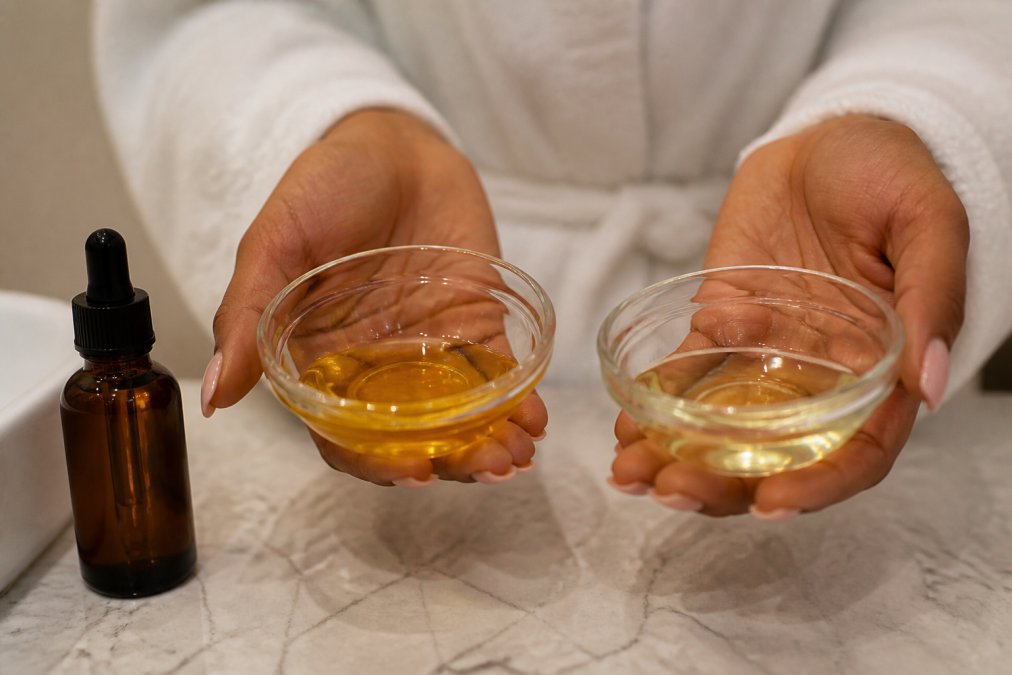
- The water drop test. Add a drop of oil to a glass of room-temperature water. Authentic castor oil is dense and tends to sink or hold together as a bead rather than dispersing instantly into a thin film. A drop that shatters into a slick rainbow film on contact usually means a lighter carrier oil is present.
- The viscosity check. Rub a small amount between your fingers. Real castor oil is notably thick, sticky, and slow to spread, thanks to its high ricinoleic acid content (PubMed). If it slides like olive or grapeseed oil, it's been cut.
- The scent check. Genuine oil has a faint, earthy, slightly nutty aroma, not a sharp chemical or perfume-like smell. A sour or crayon-like smell points to rancidity, not necessarily a fake.
- The cold test. Refrigerate a small sample for an hour. Authentic castor oil thickens dramatically when cold rather than staying thin and runny. This is the single most reliable home test, because ricinoleic acid's molecular structure makes the oil unusually sensitive to temperature.
- The absorption test. Apply a drop to your skin. Real oil sits on the surface for a while before absorbing, while heavily diluted oil tends to disappear almost immediately.
The Viscosity and Texture Test
Viscosity is the single most reliable home indicator of authenticity. Castor oil is one of the thickest plant oils available, thanks to its ricinoleic acid content, also central to its hair and scalp reputation. If it pours like a lightweight carrier oil, it's been cut.
One caveat: viscosity drops as oil oxidizes. An authentic bottle open two years on a sunny shelf pours thinner than a fresh one. Before calling a product fake, check smell and color too, if all three have shifted together, it's probably age, not adulteration.
The Scent and Fragrance Test
Authentic oil smells like the bean it came from: earthy, slightly smoky, subtle. A strong floral or perfumed scent usually means fragrance was added to mask a diluted base. A sharp, solvent-like smell points to chemical processing rather than traditional extraction.
Fake vs. Rancid: How to Tell the Difference
Most guides skip this distinction, but the two problems have different fixes. A fake oil is fraud, return it. A rancid oil is authentic but past its prime, replace it and store the next bottle better.
| Signal | Fake or Diluted | Rancid (Authentic but Expired) |
|---|---|---|
| Smell | Perfumed, chemical, or solvent-like | Sour, crayon-like, or "off" |
| Color | Flat, uniform, or artificially darkened | Cloudy or murky, often darker than fresh |
| Texture | Thin from the first pour | Thick at first, then thins as it ages |
| Cold test | Stays thin when refrigerated | Still thickens, just less dramatically |
| Fix | Return or discard | Replace and store dark and cool |
If your oil fails the cold test and smells sour, it's likely rancid rather than fake. If it fails the cold test but smells fine, dilution is more likely. Run at least three checks before concluding, no single home test is definitive.
Packaging, Labels, and Supply Chain Transparency
Packaging tells you how much the maker wants you to know. A legitimate bottle lists the extraction method, bean origin, and a batch or lot number traceable to a production run. Vague labels saying "pure" or "natural" with no sourcing detail are a common trait of counterfeit and diluted products.
Look for dark glass or opaque packaging, since light degrades oil. Check that the label names a specific origin rather than a generic region, and be wary of any product that can't say where its beans came from. Transparency is a feature, not a marketing extra.
How to Actually Verify a Sourcing Claim
Most guides stop at "check for a batch number." That's the starting line, not the finish. Here's how to push a claim from marketing copy into something you can confirm:
-
Match the lot number to a production window. A real lot number usually encodes a date or batch code (for example,
HB-2405-07suggests a May 2024 run). If the seller can't tell you roughly when that batch was pressed, the number is decoration. - Ask for the press location, not just the country. "Made with Haitian beans" and "pressed in Haiti" are different claims. A brand that presses domestically from imported beans is legitimate, but it should say so plainly rather than implying artisanal island production.
- Cross-check the seller's story across channels. The origin on the product page, the brand's About page, and the label should agree. Contradictions are one of the most reliable red flags, because counterfeiters rarely keep a consistent narrative.
- Look for a named producer or cooperative. Brands with real supply chains can usually name the farm, co-op, or region their beans come from. "Sourced from Haiti" with no further detail is a claim, not a chain.
What a Certificate of Analysis (COA) Should Actually Show
A COA is a lab report documenting what's in a batch of oil. Counterfeiters sometimes post a generic or recycled COA to look credible, so knowing what a real one contains matters:
- A specific lot number matching the bottle you're holding, not a blank or a different batch.
- A named testing laboratory with contact information, not a logo with no address.
- Ricinoleic acid content. Authentic castor oil is roughly 80-90% ricinoleic acid (PubMed). A much lower figure suggests dilution with a cheaper carrier oil.
- A test date within a reasonable window of the batch's production, not years earlier.
- Adulterant screening for common cut agents like mineral oil, soybean oil, or sunflower oil.
If a brand advertises "lab tested" but won't share the report, treat that as a soft no. Legitimate makers keep COAs on file and will send one for the batch you bought.
Regional Production: Artisanal vs. Industrial
Traditional Haitian production is small-batch: beans are roasted, ground, and pressed in limited runs, which is why color and texture vary bottle to bottle. Industrial production runs larger volumes with more consistent output, not inherently bad, but it changes what "authentic" looks like. An industrial bottle may be perfectly uniform and thin, which the home tests will flag as suspicious even when the oil is real. Judge consistency against the stated method, not a single mental image of "real" oil.
| Check | What Authentic Oil Shows | What a Fake Often Shows |
|---|---|---|
| Color | Golden-amber to dark brown, uneven depth | Flat, uniform, or artificially pale/dark |
| Texture | Thick, sticky, slow to spread | Thin, watery, absorbs instantly |
| Scent | Earthy, faint, nutty | Perfumed, sharp, or chemically |
| Sediment | Trace natural residue | None at all, or a chalky layer |
| Label | Batch number, origin, extraction method | Vague "pure/natural" claims only |
| COA | Named lab, matching lot, ricinoleic acid % | Generic or missing report |
Haitian Black Castor Oil vs Jamaican Black Castor Oil
The two oils share a name and heritage but differ in processing and texture. Haitian black castor oil, often called Lwil Maskriti, is traditionally lighter in color and texture, while Jamaican black castor oil is processed with higher ash content, giving it a thicker body and darker, smokier appearance. Neither is "better" in the abstract; the right choice depends on your hair and scalp.
If you want the lighter feel of Haitian oil with the heavier, ash-rich body of the Jamaican style, a 1:1 blend is a practical middle ground. Doyley's Premium Haitian and Jamaican Black Castor Oil 1:1 Blend combines both in one bottle, which is useful if you're unsure which texture suits your hair type.
How to Use Haitian Black Castor Oil for Hair Growth
Consistency matters more than quantity. Apply a small amount to your scalp two to three times a week, massage for a few minutes to support circulation, and work the remainder through your ends to reduce breakage. For fine or thin hair, start with very little and focus on the scalp rather than the full length, since the oil is heavy and can weigh down lightweight textures.
You can also use it as a pre-wash treatment, letting it sit 20 to 30 minutes before shampooing. Give any routine several weeks of steady use before judging results, since hair growth cycles move slowly. Doyley's Haitian Black Castor Oil 4oz is a straightforward starting point if you want to test how your hair responds before committing to a larger bottle.

Shelf Life and Oxidation: Signs Your Oil Has Gone Bad
Even authentic oil has a shelf life, and oxidation is the quiet reason many people think their castor oil "stopped working." Castor oil is relatively stable compared to lighter oils, but it still degrades over time, especially with heat, light, and air (PubMed). Signs include a rancid or sour smell, noticeably thinner texture, and a shift toward a cloudy or murky color.
Store your bottle in a cool, dark place with the cap tightly sealed, and avoid a steamy bathroom. If your oil develops an off smell or turns cloudy, replace it rather than trying to salvage it.
Figuring out how to spot fake Haitian castor oil comes down to patience and a few consistent checks: color that varies naturally, thickness you can feel, a subtle earthy scent, and a label that tells you where the oil came from. Doyley's Beauty Care sources its oil from castor beans indigenous to Haiti and offers it in sizes built for real routines, from the 4oz bottle to the 8oz option and the Haitian and Jamaican blend. Get started with Doyley's Beauty Care and give your hair and scalp a product you can actually verify.
Frequently Asked Questions
What color should real Haitian black castor oil be?
Authentic Haitian black castor oil ranges from light golden-amber to medium dark brown, depending on how the beans were roasted. It should look translucent when poured thin, not cloudy or neon-bright. A color that is uniformly pale yellow with no depth often signals a refined or diluted product. If the bottle looks identical to cheap cooking oil, treat that as a warning sign and check the label and batch number before buying.
Does authentic Haitian black castor oil have a specific smell?
Yes. Real Haitian black castor oil has a distinct roasted, nutty, slightly smoky scent because the beans are traditionally roasted before pressing. It should never smell like perfume, coconut, or nothing at all. A strong synthetic fragrance usually means the manufacturer added scent to mask low-quality or diluted oil. If the smell is faint and chemical, or if it disappears within minutes, that is a red flag worth investigating.
Is Haitian black castor oil better than Jamaican black castor oil?
Neither is objectively better. Haitian black castor oil, called Lwil Maskriti in Creole, is typically lighter in color and texture with a milder roasted smell. Jamaican black castor oil is processed with more heat and ash, giving it a thicker consistency and darker color. If you want a heavyweight oil for scalp sealing, Jamaican works well. For finer hair or daily scalp application, Haitian is easier to spread without buildup.
How long does it take to see hair growth results from Haitian black castor oil?
Most people notice less breakage and a calmer scalp within four to six weeks of consistent use. Visible length gains typically take three to six months because hair grows roughly half an inch per month. Massage the oil into your scalp two to three times a week and let it sit for at least 30 minutes before washing. Results depend on consistency, your hair type, and whether the oil you bought is actually pure.