

How to Use Black Castor Oil for Scalp Massage
Table of Contents
- Why Black Castor Oil Belongs in Your Scalp Routine
- What You'll Need Before You Start
- How to Apply Black Castor Oil to Scalp: Step by Step
- Scalp Massage Technique: Pressure, Duration, and Frequency
- How Long to Leave Black Castor Oil in Hair
- How to Wash Castor Oil Out of Hair Without Residue
- Suitability, Sensitivity, and Patch Testing
- Common Mistakes to Avoid
- Frequently Asked Questions
Last Updated: October 17, 2026
Why Black Castor Oil Belongs in Your Scalp Routine
Black castor oil is a thick, nutrient-rich plant oil pressed from castor beans, long used in Caribbean hair care for scalp and hair conditioning.
At Doyley's Beauty Care, we work with authentic Haitian black castor oil because its texture suits this job.

One honest note: a consistent scalp massage routine can support a healthy-looking scalp, add moisture, and reduce breakage so hair keeps its length, the realistic goal this guide is built around.
What You'll Need Before You Start
Gather your supplies first so you are not hunting for a towel with oily hands. Setup takes about two minutes.
- A bottle of black castor oil
- A small bowl or your palms for warming
- A wide-tooth comb for parting
Choosing Your Oil
Thick, unrefined Haitian black castor oil works well for scalp massage because it stays put. Doyley's Haitian Black Castor Oil comes in 4 oz and 8 oz bottles, both hexane-free and pressed from castor beans indigenous to Haiti.

Fine-haired readers often ask whether this oil will weigh their hair down. It can, if you use too much.
Setting Up Your Space
Work in a bathroom or over a towel you do not mind staining, since black castor oil is dark and thick and can mark light fabric. Pull your hair back loosely and keep clips and cap within reach.
How to Apply Black Castor Oil to Scalp: Step by Step
Here is the short answer: part your hair into sections, warm a small amount of oil, then massage it into the scalp with your fingertips for five to ten minutes.
The full process takes about fifteen minutes, plus however long you leave the oil in.
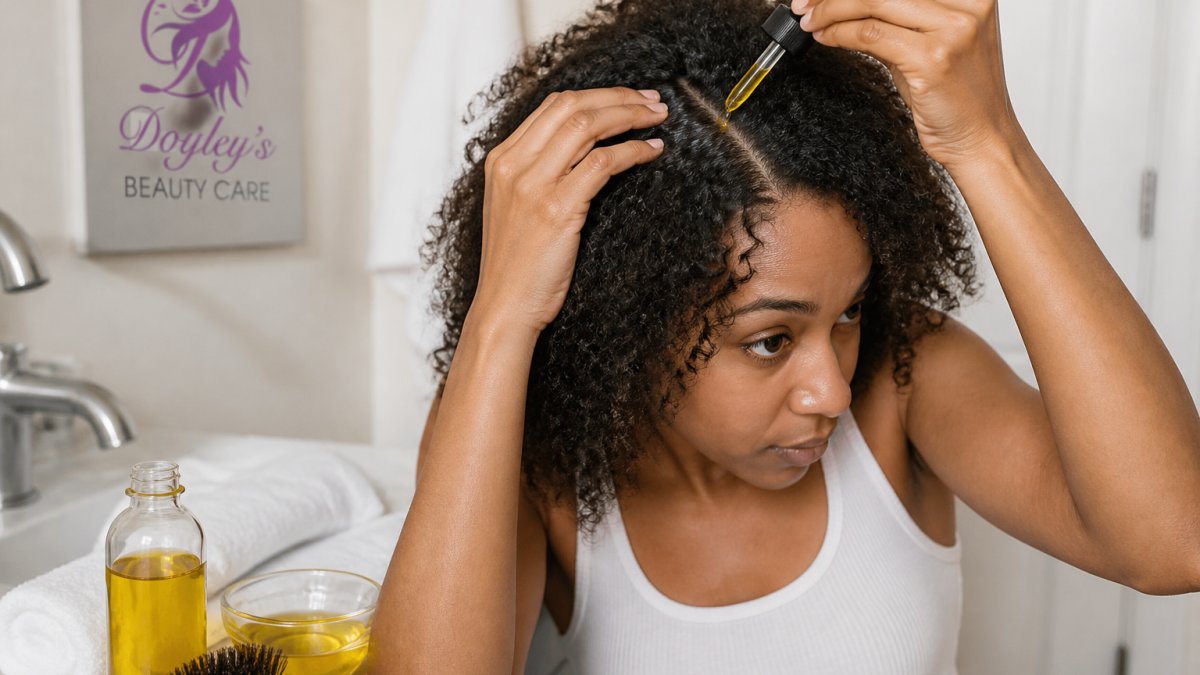
Step 1: Section and Prepare
- Detangle dry hair gently with a wide-tooth comb.
- Divide hair into four to six sections.
- Clip each section out of the way.
- Part down the middle of the first section to expose the scalp.
Working in sections is the difference between real scalp coverage and oil sitting on top of your hair.
Step 2: Measure and Warm the Oil
- Pour a small amount into your palm, about the size of a dime per section.
- Rub your palms together for a few seconds to warm the oil.
- Add more only if the section still feels dry.
Warm oil spreads further than cold oil. You will use less and get better coverage. If you prefer a diluted mixture, blend a few drops of black castor oil with a lighter carrier oil in a small bowl.
Step 3: Massage and Distribute
- Dip your fingertips into the oil.
- Press gently into the scalp at the hairline.
- Move in small circles, lifting and pressing rather than dragging.
- Work from the hairline back toward the crown.
- Repeat through each section.
- Finish by smoothing a trace of oil along your roots and edges.
Use your fingertips, not your nails, the pads give steady pressure without scratching.
Scalp Massage Technique: Pressure, Duration, and Frequency
Aim for five to ten minutes of massage, three times per week, enough to build a habit without turning it into a chore. Technique decides whether your fingers reach the scalp or just slide over your hair.
Hand Position and Pressure
Use the pads of your fingertips, never your nails. Rest your hands on your head with fingers slightly spread so each fingertip sits on a different part of the scalp. Press down until the scalp moves a little under your fingers, firm, but never painful. If you feel stinging or tenderness the next day, you pressed too hard.
A Repeatable Five-Minute Routine
Work in the same order every time so you do not unconsciously skip the back of your head.
- Hairline (1 minute). Place fingertips along the front hairline and walk them in small circles from temple to temple.
- Crown (1 minute). Move to the top of the head and work outward in small circles, lifting and pressing rather than dragging.
- Sides (1 minute). Above each ear, use gentle pinch-and-lift motions along the temple and side hairline.
- Nape (1 minute). Tilt your head forward slightly and work the back hairline and the base of the skull with small circles.
- Full sweep (1 minute). Finish by sweeping fingertips from the hairline back toward the crown in slow, even strokes.
Set a timer for five minutes if you tend to rush. Ten minutes is plenty for a longer session; beyond that, most people get tired hands and press unevenly.
Coverage and Sectioning
If your hair is thick or coily, part it into four to six sections and massage one at a time for real scalp coverage. For fine or straight hair, you can often work without clips, but still part small rows so your fingertips reach the scalp rather than the surface of the hair.
Frequency by Hair Type
- Curly and coily hair: three sessions a week is usually comfortable.
- Wavy hair: start with once or twice a week.
- Fine or low-porosity hair: once a week with a lighter hand and fewer drops of oil.
You can also do a dry massage, no oil at all, between wash days if your scalp feels tight. The pressure and movement are the point; the oil gives your fingers slip and conditions the scalp.
How Long to Leave Black Castor Oil in Hair
Leave black castor oil in for at least 30 minutes as a pre-wash treatment, or overnight for deeper conditioning. There is no benefit to leaving it in for days, and doing so just makes it harder to wash out.

Choose based on your schedule and your hair's tolerance.
Timing by Treatment Type
| Treatment Type | Time on Hair | Best For | Notes |
|---|---|---|---|
| Quick pre-wash | 30 minutes | Weekly maintenance | Easiest to fit into a wash day |
| Standard pre-wash | 1 hour | Dry, tight scalps | Cover with a plastic cap while you wait |
| Heat-assisted | 30 minutes with heat | Low-porosity hair | Use a heating cap or hooded dryer on low |
| Overnight | 6-8 hours | Very dry hair and scalps | Sleep on a dark pillowcase or towel |
For overnight treatments, cover your hair with a plastic cap and then a scarf or bonnet. If you use heat, keep it on the lowest setting and never fall asleep with a heating cap plugged in.
How to Wash Castor Oil Out of Hair Without Residue
The trick to removing thick oil is to shampoo twice: once to break up the oil, once to clean the scalp. Rinse with warm, not hot, water.
Step-by-Step Washout
- Rinse with warm water for a full minute to loosen the oil, it does more work than people expect.
- Apply shampoo to your scalp first, not your ends. Use about a quarter-sized amount for short hair and a little more for long or thick hair.
- Massage gently with your fingertips for 30 seconds, working along the hairline and crown where oil collects.
- Rinse until the water runs clear.
- Shampoo a second time, focusing on the roots and hairline; this pass removes the film the first leaves behind.
- Follow with conditioner on the mid-lengths and ends only.
- Rinse with cool water to help smooth the cuticle.
Troubleshooting Residue
- Roots still feel coated: the oil was too heavy for your texture. Cut back to a few drops next time and keep the oil on the scalp, not the mid-lengths.
- Hair feels stiff or waxy: you likely used too much oil or left it in too long. A second wash day sooner than usual will help.
- Buildup after several weeks: clarify once a month with your regular shampoo and a slightly longer scalp massage during washing. If your scalp still feels coated, reduce frequency rather than adding more product.
One insider note: applying conditioner before shampoo does not remove castor oil. Conditioner is designed to coat hair, so it simply sits on top of the oil. Shampoo first, always.
Suitability, Sensitivity, and Patch Testing
Not every scalp loves a thick oil. A patch test takes a day and answers the question cheaply.
How to patch test:
- Apply a small drop of oil behind your ear or on your inner wrist
- Leave it uncovered for 24 hours
- Check for redness, itching, or burning
Suitability by hair type:
- Curly and coily hair: usually tolerates oil well; three times weekly is reasonable
- Wavy hair: start with once or twice a week
- Fine or thin hair: use a few drops only, and keep oil off the mid-lengths
If your scalp is irritated, broken, or reacting to a product, stop using it and speak with a dermatologist.
Common Mistakes to Avoid
Most disappointing results come down to technique, not the oil. These are the ones we see most often.
- Using too much oil. A generous amount feels right and performs worse. Start with a few drops.
- Skipping the massage. Coating the scalp is not the same as massaging it. The pressure and movement are the point.
- Applying to soaking wet hair. Oil and water do not mix. Dry or damp hair gives better absorption.
Our recommendation: build the routine around one wash day per week, add a mid-week massage without oil if your scalp feels tight, and keep a 4 oz bottle in rotation.
A scalp massage routine only pays off if you keep it up, and the oil you use matters as much as the technique. At Doyley's Beauty Care, we make authentic Haitian black castor oil that is thick enough to give real slip during massage and rich enough to condition a dry, tight scalp.
Frequently Asked Questions
Is black castor oil good for your scalp?
Black castor oil is rich in ricinoleic acid and omega-6 fatty acids, which give it strong moisturizing properties. For a dry, flaky, or itchy scalp, it can help soften and condition the skin. Doyley's Haitian Black Castor Oil is formulated to combat dryness while supporting a healthier-looking scalp. It is not a medical treatment, so if you have persistent irritation or a diagnosed condition, check with a dermatologist before adding it to your routine.
How much black castor oil should you use on your scalp?
Start with a small amount, about a few drops per section, and build from there. For a full scalp massage, one to two teaspoons is usually enough for most hair lengths. If your hair is fine or thin, use less to avoid weighing it down. Doyley's Haitian Black Castor Oil is potent, so a little goes a long way. Warm the oil between your palms before applying to help it spread evenly.
Should you apply black castor oil to a wet or dry scalp?
Both work, but each has trade-offs. On dry hair, the oil is easier to control and you can see exactly where it lands. On damp hair, it spreads more easily through curls and coils. Many people prefer to apply to a dry scalp before washing, then follow with shampoo. If you apply to wet hair, use a smaller amount because water can make the oil feel heavier.
How often can you massage black castor oil into your scalp?
Most people can massage black castor oil into the scalp one to two times per week. If your scalp is sensitive or your hair is fine, start with once a week and adjust based on how your hair responds. Consistent, gentle massage matters more than daily application. Always wash the oil out thoroughly after each treatment to prevent buildup that can dull curls and weigh down roots.